Every region, even every farm within a region, differs in history and soil conditions, topography and climate - demanding the same close attention and responsiveness Justin brings to his own land. "It's never simple and it's always complex. We have to think through how things interact in the local environment, and what's right here may not be right even down the road." That's why Justin never criticizes other farmers' choices, assuming they are based like his on hard-won knowledge and experience of their land. Nor is he ever defensive about his own choices, but remains open to any question or challenge to his thinking, eager to see any research that might change his mind. "I believe that we're created to be in a community and impact and learn from each other," he says. "I really like John 1: 'In the beginning was the Word: and the Word was God...Through him all things are made.'" That sacred presence throughout time and in every person means that all deserve a respectful hearing. (119)
Monday, November 28, 2016


Tuesday, November 15, 2016
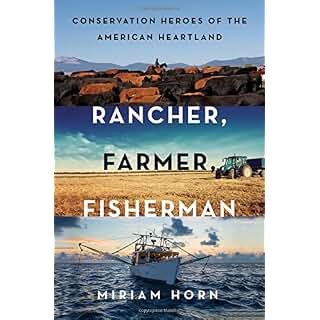
Rancher Farmer Fisherman
I'm reading an awesome book right now, haven't even finished it yet. Rancher Farmer Fisherman: Conservation Heroes of the American Heartland. I highly, highly recommend it; not only is it nuanced and complex, but it is extremely readable and beautifully written without being ostentatious about it. Miriam Horn, a NYC-based writer, visits with people who are working hard and thinking hard out here in place where the physical demands of civilization meet the natural world and the "struggle is real." Horn does not come from an agricultural background, so it is just beyond impressive how deeply she dives into the complexities of the subject. How she stays out here, on the ground, talking to the farmers, ranchers, and fisherman from different angles, and doesn't retreat to quoting university experts. She stays on the ground, in the war zone, with a generous heart and amazing curiosity. Here's a link to an interview with the author. ** I know some of you reading this could be in this book, so go check it out and find heart to keep on doing all that beautiful stuff you do!
Friday, November 11, 2016
Hunting and Fishing
There are many old fishing boats parked in back yards around here. When I was a child it was possible to make a good living as a fisherman. These are rough, treacherous seas where strong currents sweep the cliffs and fierce winds push higher the swells born in the deep ocean. It is a dangerous place to fish, but in the seventies, powerful, affordable marine engines made it possible for any able-bodied, high-couraged young man to make a living fishing for yellowfin tuna. For a time.
There was a fishing boom, that lasted about a dozen years, and then a long, slow bust. When I was child the cliff mooring and the beach landing were full of boats, some of them colorfully painted old wooden boats, some the gleaming white fiberglass boats. Now there are no boats, the fish are nearly all gone, the big pelagic fish that used to run in the waters here at certain times of the year. Now there are still runs but the fish are all small. When I was a child my father would catch yellow fin tuna that weighed over one hundred pounds; now the fisherman catch “rats “ - little ten pounders. There are not enough of them to make a living anymore, except for a handful of hard-scrabble fishermen, who sell their small catches by the side of the road.
That is what resource depletion looks like, in microcosm, in a flicker of time, my life-time. Sunk costs, unsustainable yields, nostalgia for better days.
My uncle has an old boat in his back yard, my father, too. They all fished in the old days, and had their share of high adventure and close calls with our unforgiving waters. There is no drug as intoxicating as the full use of our powers hunting in dangerous conditions or against a dangerous prey. I know this from experience, not at sea but on land, hunting wild cattle. It is an experience that few women get to have, and which we may not even experience as intensely as men, but even so nothing in life made my brain light up, sharpened my senses, called up the powers of body and mind, like hunting. There is no fear and no sense of time; hunter and hunted are immersed in that single enchanted, primal world beyond thought and beyond words.
And then I had my baby, and though I long for those bright, wild, uncomplicated days, I gave it up on a level deeper than will and longing. The fierceness of hunting went into the fierceness of mothering. It took everything in me to rise to the challenge of nurturing a child - making a world for that child to flourish in, protecting her, teaching her, understanding her. I know fear and I can no longer sink myself into the divine and timeless dangers of the chase. I don’t have that luxury or that passion anymore; I am needed elsewhere. Perhaps I’ll change again when my daughter’s flown; I'll become some other kind of being under the direction of another kind of Heaven.
We can’t go back to the innocent, grand heroism of an un-depleted world. That was our childhood; it’s gone now. Our very passion for the world depleted it. No blame. It’s just not there anymore. And what we once hunted are the very things to be nurtured, in the way that a parent will empty out themselves for their child. In the way that a true fisherman will die for the sea, in the sea, gladly.
Tuesday, November 8, 2016
T.H. White's The Once and Future King
I finally got around to reading T.H. White's version of the Arthur myth and I'm kicking myself for not getting around to it sooner. Though it's just the thing I needed right now - White's good-hearted, riotous, animal-loving world has helped soothe my election anxieties.
Here's a pdf version, some OCR typos. Civilization is pretty cool sometimes. And funny.
(The Wart is the kid nick-name for the young Arthur. He gets lost in the forest early in the book.)
Here's a pdf version, some OCR typos. Civilization is pretty cool sometimes. And funny.
(The Wart is the kid nick-name for the young Arthur. He gets lost in the forest early in the book.)
"Please," said the Wart, "I am a boy whose guardian is Sir Ector."
"Charming fellah," said the Knight. "Never met him in me life."
"Can you tell me the way back to his castle?"
"Faintest idea. Stranger in these parts meself."
"I am lost," said the Wart.
"Funny thing that. Now I have been lost for seventeen years.
"Name of King Pellinore," continued the Knight. "May have heard of me, what?" The visor shut with a pop, like an echo to the What, but was opened again immediately. "Seventeen years ago, come Michaelmas, and been after the Questing Beast ever since. Boring, very."
"I should think it would be," said the Wart, who had never heard of King Pellinore, nor of the Questing Beast, but he felt that this was the safest thing to say in the circumstances.
"It is the Burden of the Pellinores," said the King proudly. "Only a Pellinore can catch it— that is, of course, or his next of kin. Train all the Pellinores with that idea in mind. Limited eddication, rather. Fewmets, and all that."
"I know what fewmets are," said the boy with interest. "They are the droppings of the beast pursued. The harborer keeps them in his horn, to show to his master, and can tell by them whether it is a warrantable beast or otherwise, and what state it is in."
"Intelligent child," remarked the King. "Very. Now I carry fewmets about with me practically all the time.
"Insanitary habit," he added, beginning to look dejected, "and quite pointless. Only one Questing Beast, you know, so there can't be any question whether she is warrantable or not."
"Charming fellah," said the Knight. "Never met him in me life."
"Can you tell me the way back to his castle?"
"Faintest idea. Stranger in these parts meself."
"I am lost," said the Wart.
"Funny thing that. Now I have been lost for seventeen years.
"Name of King Pellinore," continued the Knight. "May have heard of me, what?" The visor shut with a pop, like an echo to the What, but was opened again immediately. "Seventeen years ago, come Michaelmas, and been after the Questing Beast ever since. Boring, very."
"I should think it would be," said the Wart, who had never heard of King Pellinore, nor of the Questing Beast, but he felt that this was the safest thing to say in the circumstances.
"It is the Burden of the Pellinores," said the King proudly. "Only a Pellinore can catch it— that is, of course, or his next of kin. Train all the Pellinores with that idea in mind. Limited eddication, rather. Fewmets, and all that."
"I know what fewmets are," said the boy with interest. "They are the droppings of the beast pursued. The harborer keeps them in his horn, to show to his master, and can tell by them whether it is a warrantable beast or otherwise, and what state it is in."
"Intelligent child," remarked the King. "Very. Now I carry fewmets about with me practically all the time.
"Insanitary habit," he added, beginning to look dejected, "and quite pointless. Only one Questing Beast, you know, so there can't be any question whether she is warrantable or not."
Saturday, November 5, 2016
The Making of Names
We've been doing agriculture for some time now. So long that we've forgotten what it is. We think it's just one form of business rather than the mother of all businesses, social endeavors, and civilizational achievements. Agriculture is there invisibly undergirding art and software engineering, fashion and nanotechnology, every big and little thing about civilization. And agriculture is short hand for the enslavement of animals and plants by humans. That's the cold hard truth of it.
One of the first rules of agriculture is: if you intend to eat it, do not give it a name. Naming something creates a personal relationship. Responsibility. Ethical quandaries. Emotional complexities. The opposite of naming something is quantifying it. This erases the personal relationship. Thing becomes number, an abstraction, a percentage, a ratio. Agriculture, as a form of science and technology, is all about quantification. Big Data is what we're all supposed to be worshipping these days.
When I was an undergraduate at the University of Oregon I crashed a graduate seminar in the Comparative Literature department on Critical Theory. I immediately got outed as an interloper when the professor had everyone introduce themselves and all the grad students had something marvelously intricate to say except for me, who had no idea what Critical Theory was, at all. But the professor was welcoming and amused at my enthusiasm. He proceeded to give a talk about names and naming in a way that made my hair stand on end in sheer intellectual excitement. He talked about how a name is not just a label that you put on things but that there is a story behind and within the name, a field of meanings and emotions, desires, politics, histories, loves and pains. (For instance, if you have a brother or a childhood friend named John, you'll never meet anyone named John without some traces of predetermined feelings.)
This is where I have an argument with agriculture and science and technology. I want to name the world rather than quantify it. And I don't mean the scientific name, which is just another way of quantifying. What I am interested is the name that you use with another person like "John" or "Amy," or the name that you give your dog or cat that binds the two of you together or the name of a place where you have lived and evokes an entire period of your life that is gone forever and yet latent in you as your history and memory. I am interested in names that are filled with some tenderness and regard, names that doesn't even pretend to be objective. These are the kinds of names that structure our lives even though we, for the most part, are unconscious of their subtle shaping.
The kind of agriculture that I am interested in makes names rather numbers. Which is to say I'm not going to make a very good businesswoman. My attention tends to wander. I can barely rationalize what I do for a living; it is at best the most honest way to make a living that I know of. It is a seeking. I try to enact an emotionally complex agriculture that takes the risk of naming the world.
Can we name a corn-field as well as a city? Can we name a steer that we know we will kill, and honor it as a being with a name? Could we bear that pain? Can we name each individual chicken, each row of broccoli? The wild tree, the landscaping shrubs? Could we respect every living thing as if it had a name? Probably not. But it would do us good to try. It would make us better people - more honest, more humble, more heedful.
One of the first rules of agriculture is: if you intend to eat it, do not give it a name. Naming something creates a personal relationship. Responsibility. Ethical quandaries. Emotional complexities. The opposite of naming something is quantifying it. This erases the personal relationship. Thing becomes number, an abstraction, a percentage, a ratio. Agriculture, as a form of science and technology, is all about quantification. Big Data is what we're all supposed to be worshipping these days.
When I was an undergraduate at the University of Oregon I crashed a graduate seminar in the Comparative Literature department on Critical Theory. I immediately got outed as an interloper when the professor had everyone introduce themselves and all the grad students had something marvelously intricate to say except for me, who had no idea what Critical Theory was, at all. But the professor was welcoming and amused at my enthusiasm. He proceeded to give a talk about names and naming in a way that made my hair stand on end in sheer intellectual excitement. He talked about how a name is not just a label that you put on things but that there is a story behind and within the name, a field of meanings and emotions, desires, politics, histories, loves and pains. (For instance, if you have a brother or a childhood friend named John, you'll never meet anyone named John without some traces of predetermined feelings.)
This is where I have an argument with agriculture and science and technology. I want to name the world rather than quantify it. And I don't mean the scientific name, which is just another way of quantifying. What I am interested is the name that you use with another person like "John" or "Amy," or the name that you give your dog or cat that binds the two of you together or the name of a place where you have lived and evokes an entire period of your life that is gone forever and yet latent in you as your history and memory. I am interested in names that are filled with some tenderness and regard, names that doesn't even pretend to be objective. These are the kinds of names that structure our lives even though we, for the most part, are unconscious of their subtle shaping.
The kind of agriculture that I am interested in makes names rather numbers. Which is to say I'm not going to make a very good businesswoman. My attention tends to wander. I can barely rationalize what I do for a living; it is at best the most honest way to make a living that I know of. It is a seeking. I try to enact an emotionally complex agriculture that takes the risk of naming the world.
Can we name a corn-field as well as a city? Can we name a steer that we know we will kill, and honor it as a being with a name? Could we bear that pain? Can we name each individual chicken, each row of broccoli? The wild tree, the landscaping shrubs? Could we respect every living thing as if it had a name? Probably not. But it would do us good to try. It would make us better people - more honest, more humble, more heedful.
Saturday, October 29, 2016
Addictions
I came home yesterday after dark, after a day in the city, and one of the month-old puppies had climbed into a bucket of water and drowned. His mother had pulled him out, it seemed, because I found him dead next to the bucket, but she was too late. I tried to revive his limp, chill body, but I was too late as well. My sleep was haunted by guilt, sorrow, and inchoate terrors.
The mom dog slept by her baby all night, chasing her other pups away. I wonder if she too, amid the misery of loss, also feels the mystery of it - death - that sense of passings and transformation that tinges the horror and pain with a kind of wonder. As if another kind of time operates there at the edge, but one is helpless to grasp its significance. Perhaps she knows its significance better than I do. All night she slept by her baby where I had placed him in the grass, periodically licking his face and body. In the morning I dug a very small hole and buried the puppy on the hillside where his grandfather and great grandparents also lie.
Losing the puppy is just this week’s knife edge of sorrow, unexpected in its particulars but familiar in its raw exposure. I live and work on a cattle ranch, which means that I make a direct living on the life and death of animals. There are the joyful, anxious months of calving, where the pastures are dotted with fresh and shiny babies, and there are the years of overseeing their growth to maturity, and then the day when they are shipped off to be slaughtered, where I send them to their death. I don’t like the death part, no, I don’t like to think about it, but there is a very big part of me that needs it, like an addictive drug or an obsessive cause. I need death to be there lurking in my life, or I would have to find something else to substitute for it, like alcoholism or jihad.
This could just be a defect of my personality, as I’ve always had an above-average fixation with altered states of consciousness, intensities, extremes, and other sorts of follies and ridiculousness. I do a decent impression of solid citizen these days, when necessary, but I’m always a bit ragged around the edges on closer inspection. I live too far out there to not be marked by a certain awkwardness. Out there - out here - is where I can feel the systole and diastole of death and life rolling through me without impediment. It is my secret drug, my secret well of renewal. An open secret, secret only because I can’t explain it at all well or pass it on, as one is supposed to do with human culture.
So, this is just another story of addiction, which is to say a story of quiet rebellion against the social order, or capitalism, or repressive standards of behavior, or civilization itself. I don’t know anymore - perhaps it is the kind of rebellion that just makes order stronger, and I’m OK with that. Social cohesion is something to be treasured; that is one of the lessons that we must very reluctantly learn from the Arab Spring and its aftermath: that even a repressive order might be preferable to the free-for-all of destruction and murder that can take its place.
But I think my addiction has deeper roots and is the most conservative kind of rebellion possible. I want what we always had until not too long ago: that atavistic world, so unjust by liberal humanist standards, but absolutely just along longer ecological timelines. I want my life entwined with the lives and plants and animals because their lives are a truth deeper founded than the tangles of philosophy.
Those are luxuries I have claimed for myself, the luxuries of sharp-edged experience and open spaces; they are unpopular, nearly free for the taking, however strenuous that taking might be. Digging the hole into which to put the puppy I weep inside for all of us, that we might die, that we have to die, that we must go on, and that it is so hard to hang on to what is essential.
Tuesday, October 25, 2016
Innovations without a city
Civilization has always been practiced in cities. It's right there in the word itself. But a city might not be fundamentally necessary for the practice of civilization anymore, what with the web and all.
The model of civilization has been city-centric for few millennia now. As in, the produce of the countryside is sucked into the city, to fuel the business of civilization, in all its self-involved glory. The cities have justified this by citing the innovations they produce: political, economic, scientific, technical innovations that raise the whole system up.
But what if we've taken that pattern to its logistical and logical limit? What if all of the innovations of the cities have run their course, and no longer produce any marginal returns for the whole? What if the pattern of city-centrism has done everything it can do and now the places where the essential innovations need to happen are out in the country or even in the wilderness? Or in the urban gardens and other eruptions of the country within the city? What if the essential innovations that we need to make as a civilization have nothing to do with concentrations of humans, but in a fundamental re-thinking of the relationship between human civilization and nature?
This kind of innovation doesn't even have a name yet. It would be fundamental, as in changing the foundational pattern of civilization, from a strongly centripetal pattern to something more balanced. Changing the economic relationship between the city and the country, and between civilization and nature has profound implications for the health of eco-systems, for the psychological and physical health of humans.
And there are a bunch of people already working on it, feeling their way towards innovations they can't even name, and might not work out. Innovations that build on the best that the cities produce but that question the assumption that only cities and its citizens can do civilization and innovation.
The model of civilization has been city-centric for few millennia now. As in, the produce of the countryside is sucked into the city, to fuel the business of civilization, in all its self-involved glory. The cities have justified this by citing the innovations they produce: political, economic, scientific, technical innovations that raise the whole system up.
But what if we've taken that pattern to its logistical and logical limit? What if all of the innovations of the cities have run their course, and no longer produce any marginal returns for the whole? What if the pattern of city-centrism has done everything it can do and now the places where the essential innovations need to happen are out in the country or even in the wilderness? Or in the urban gardens and other eruptions of the country within the city? What if the essential innovations that we need to make as a civilization have nothing to do with concentrations of humans, but in a fundamental re-thinking of the relationship between human civilization and nature?
This kind of innovation doesn't even have a name yet. It would be fundamental, as in changing the foundational pattern of civilization, from a strongly centripetal pattern to something more balanced. Changing the economic relationship between the city and the country, and between civilization and nature has profound implications for the health of eco-systems, for the psychological and physical health of humans.
And there are a bunch of people already working on it, feeling their way towards innovations they can't even name, and might not work out. Innovations that build on the best that the cities produce but that question the assumption that only cities and its citizens can do civilization and innovation.
Subscribe to:
Posts (Atom)


