Saturday, April 30, 2016

Entertainment

Every so often I like to pick up books at semi-random off the new books shelf in the library.    One of the serendipitous discoveries this round is a reprint of D.H. Lawrence’s Mornings in Mexico (1934), a collection of essays from his time in Mexico and the Southwest of the US.  

I’ve never been able to get very far into Lawrence’s famous novels, but I’ve loved his wild, hypnotic poetry since I was a teen.  I think you could accuse Lawrence of various kinds of intellectual sins; his writing is both baroque and brutal: opinionated, patronizing, flat-out ridiculous half the time, but the rest of the time he’s more right than any careful, thoughtful, tactful writer could ever be.  So it is with the thinking of poets I suppose: for the most part indefensible but occasionally crucial. 

His most striking essay in the collection is “Indians and Entertainment” in which he compares the metaphysics of Western drama with the anti-metaphysics of Indian communal ceremonies.  

Lawrence says of the Western tradition of entertainment from classical Greek drama to Hollywood: “The secret of it all, is that we detach ourselves from the painful and always solid trammels of actual existence, and become creatures  of memory and of spirit-like consciousness.  We are the gods and there’s the machine, down below us.”  From drama we’ve progressed to the cinema and modern man’s passion for movies: “In the moving pictures he has detached himself even further from the solid stuff of earth.  There, the people are truly shadows; the shadow-pictures are thinkings of his mind.  They live in the rapid and kaleidoscopic realm of the abstract.  And the individual watching the shadow-spectacle sits a very god, in an orgy of abstraction, actually dissolved into delighted, watchful spirit.”

We have many vices in the West.  Some of our vices are ruthlessly destructive.  This vice, this addiction - our lust for entertainment - is the one that may well be self-destructive.  It is slowly luring us into an abstracted, distracted passivity.

Of the Native American/Indian idea of entertainment, Lawrence says, “ He hasn’t got one.”

He says that the consciousness of the Indian and the West are irreconcilable, fatal to each other: “That is, the life of the Indian, his stream of conscious being, is just death to the white man. And we can understand the consciousness of the Indian only in terms of the death of our consciousness.”  By this dichotomy, Lawrence tries to show up the dishonesty of well-meaning, enlightened Westerners who consume Indian communal performances as entertainment and spectacle.

“The Indians dance around the drum, singing”   Theirs is not an entertainment but an experience, a renewal, repetitive, wordless, meaning nothing but joining everything together, no beginning and no end.

“Yet perhaps it is the most stirring sight in the world, in the dark, near the fire, with the drums going, the pine-trees standing still, the everlasting darkness, and the strange lifting and dropping, surging, crowing, gurgling, aah-h-hing! of the male voices.”

The Indian ceremonial is a direct experience of the wonder of the world, in the deep places “of the blood” and shared life.

Lawrence says a great deal more about the Indian ceremonies and dances and a modern anthropologist would shudder at most of what he has to say.  He shamelessly projects his own artistic obsessions onto Indian ceremonials.   

And yet, there is the door he cracks open for us, we entertainment-besotted global consumers tethered to our smartphones, our Netflix and HBO.  

We could experience the world again, instead of succumbing to our entertainment.  If we experienced it, perhaps we would love it with the intensity we need to summon to nurture life as a conscious goal.  This would be a startling innovation within our civilization, which has always more or less taken life for granted.


To experience the world costs nothing, but we may have to die to everything we think we know about the world to walk away from entertainment.  Perhaps it is more dangerous than we can possibly imagine.  The abstractions in which we are enthralled, perhaps they protect us from the harsh realities of our own  voracious human nature.  We may have gone way past the possibility of experience as a chosen thing, and must make do with the virtual delights of civilized entertainment because there are simply too many of us humans.  Without the resource extraction efficiencies of the global economic machine we would not be able to keep ourselves fed, and without the entertainment complex we would see all too clearly our growing imprisonment in our own economic machine.  That may be the cold, hard truth of the next few decades, but I'll not stop acting as if we can choose otherwise.

Friday, April 29, 2016

What is a brain?

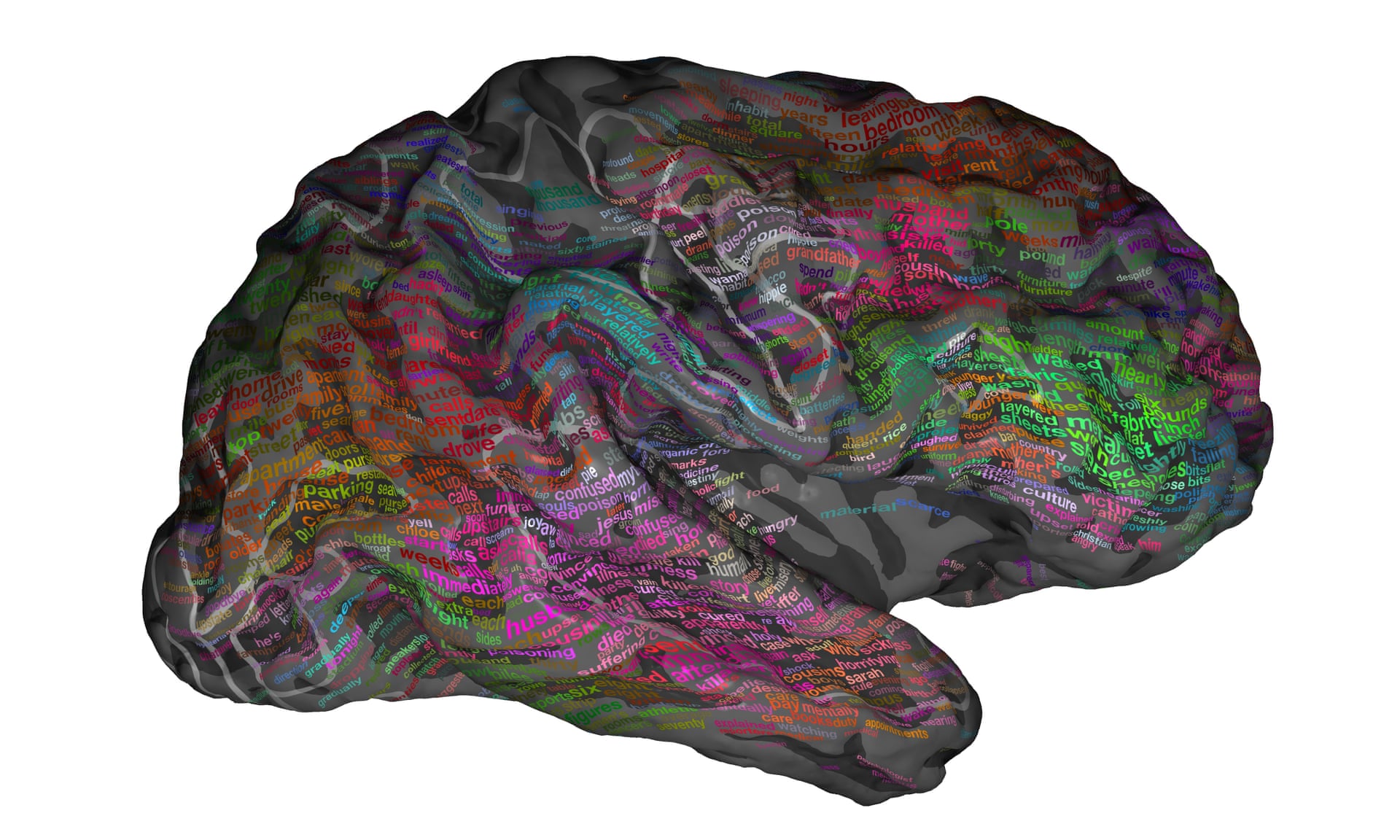
"Scientists" have built a map of how words activate the brain. (I wish we would stop doing that, conferring the mantle of the All-Powerful Oz that goes with the word "scientist" upon what amounts to some guys and girls who happen to have a certain kind of eduction and access to some fancy equipment; I'm imagining the headline "Literary Critics discover how words are organized" or "Ranchers build multispecies biomimetic symbiotic system")  This was done by putting some people in an MRI scan and reading stories to them.  So, it was a bit of a literary enterprise.  I wonder when, if ever, we will come to see our minds as bigger than our brains.  Or care that our brains are not only lit up by words and numbers but by our natural environment as well, and that those connections are more important to the brain, to the entire organism, than our relatively recently acquired verbal and symbolic skills.


https://www.theguardian.com/science/2016/apr/27/brain-atlas-showing-how-words-are-organised-neuroscience


Tuesday, April 26, 2016

Hominid

I've been reading:


which has been helping me with the aforementioned project of stripping away some of the human obsessions and seeing us for the hominid/primate animal that we are.  Tattersall, in fact, makes the point that the theoretical framework of the field of paleoanthropology (finding and interpreting hominid fossils) has been seriously skewed by a persistent insistence on seeing ourselves as the crowning glory of all creation (he calls it human exceptionalism), such that all hominid fossils lead to us, when in fact the fossil record may indicate a more complex family tree, in which we had cousins and distant hominid relatives.  Who might be around now but we pretty much ate them.  Okay, out-competed them, part of which might have involved eating them.  That explains a lot about us, about how we're so damn afraid of ourselves, and have a passion for depictions of hominid on hominid violence.  If you're a geek like me, Ian Tattersall's books, of which there are many, are a great read.  Especially after feminist quantum physics.   You'll not think about being human the same again.  

Sunday, March 6, 2016

Meeting the Universe Halfway: Quantum Physics and the Entanglement of Matter and Meaning


I bet you didn't know that there was such a thing as feminist quantum physics, but here you have it.  I love this illustration and the general argument of Karen Barad's Meeting the Universe Halfway which, like Bruno Latour's work, examines the social construction - the genealogy - of science and the ways of life that such science gives birth to.

In the hierarchy of human dream-worlds this is pretty stratospheric stuff - but it circles around to the foundations, to our most basic relationship with matter itself.  So it really isn't feminist, or it is, but the point being that feminism is not just for women or about women, but as it grows and deepens it has become about all of us, even non-human, non-living matter itself, and how our conception of matter can work itself free from certain cultural assumptions which could be summed up as 'might makes right'.  So we come to understand that we don't discover the universe - we being us mighty humans and the universe being particles that we have the right to experiment upon,  blow up, cause to collide, etc. - but that the kinds of instruments and apparatus that we build to measure the universe determines the universe that we find. And further that the kinds of instruments that we build are shaped by the social world in which we develop, with all of the assumptions encoded in that world.  So for instance a social world that has been set up to reward physical might (and males generally are bigger and stronger than females) will find a universe where physical power - a physics of force and leverage, a biology of competition -  are defining features.  But other possibilities are possible, and feminism helps offer that to everyone.

Quantum physics, in this illustration, looks a bit like one of Lynn Margulis' microbes, don't you think?

Thursday, March 3, 2016

Elm Tree Farm (cont.)

My earliest memory is of coming downstairs in the morning in my red flannel nightie with white feather-stitching on it, and sitting in Grandfather’s lap in front of the dining room fireplace, until Mother was ready to dress me.  I was three or four.  I remember, too, following Grandfather about as he raked leaves in the yard and took them in the wheelbarrow to the barn for bedding.   I could ride in the wheelbarrow on the return trips.

I’ve been told that I tried to imitate him by planting my feet as he did and walking with my head bowed in deep thought, with my hands clasped behind me, and was mightily indignant at a burst  of laughter it caused.

Grandfather died when he was eighty-four, one April day, in some way I slipped into the room where he lay, and probably unnoticed, I saw and heard his labored breathing.  Pneumonia is too much for one of his years.

The funeral service was long.  As was the custom, I presume there was a sermon.  I remember kneeling at my small chair and also remember singing.  I sang myself; everybody sang.  One thing they sang, “Shall We Gather at the River”.  Perhaps none of you of a younger generation have ever heard it.  The music is sweet and has a note of triumph too. The words are so different from many hymns in use today, I’ll write down the first verse:

     “Shall we gather at the river
      Where bright angel feet have trod,
      With its crystal tide forever
      Flowing by the feet of God?
Chorus
      Yes we’ll gather at the river
      The beautiful, the beautiful river
      Gather with the saints at the river
      That flows by the throne of God.”

I was not taken to the grave, but I saw them put the coffin with Grandfather in it in the hearse.  Perhaps old pictures will give you youngsters an idea of the difference between a hearse of 1876, and the present day.  I remember that one, I was only three and one half years old.

Grandfather’s property was divided between Aunt Louise Goddard and Father.  Father had the farm, what else I do not know.

Of course remembrance of incidents at this tender age is somewhat sketchy.  It was probably later in the spring of the year Grandfather died that I had an adventure with, of all things, a summer yellow bird.

Out side one of the windows of the sitting room grew a beautiful honeysuckle bush, or tree.  The window was open and Mother sat by it sewing.  I was playing around outside and found the shell of a bird’s egg on the ground under the honeysuckle tree.  A pair of yellow birds had their nest in the tree and the shell had been pushed out.  Of course I was interested and picked up the shell.  Those birds were as brave as if they were big as elephants and flew screaming and scolding at me lighting on my head, and scaring me almost to death.  Of course Mother came to the rescue but by the time she arrived those birds had so tangled their feet in my curls that she had to cut away hair to free them.

Along about that time too, I got the scar on my arm.  Mother had gone to Genesee and left me with good, kind Mag Shaw who was helping her in the kitchen at the time.  Tom and the hired man got into some kind of frolic.  The hired man was chasing Tom with a corn knife in his hand.  I wanted to see the fun, but of course got in the way, and the man fell over me giving me a wicked cut.  I don’t remember this part of it, but I do remember being stood up on the kitchen table after Mother got home, and how she and Mag Shaw cried when they undid the bandage to look at the cut. 

Tuesday, March 1, 2016

Unconscious

at night we revert to our animal selves
walk our dreams
untrammeled by reason
open skies
dark trees
a merry-go-round
old songs
can't even follow us
back there

red riding hood would lurk on wolf-haunted lanes
a path to the withered goddess
cinderella sacrifices farm animals
hunch-backed horse and chicken-legged hut
breadcrumbs glow in the forest

in the morning
I put on my name again
my nationality and my skin
take up arms
and functions
though why I've forgotten
why

Sunday, February 28, 2016

Elm Tree Farm (cont.)

(The Memoir of my Great Grandmother, Bertha Dodge Nellis)

Part II.  
Early Memories

They were building the sheep shed on the north side of the barnyard in November 1872.    That meant added help in an already large family.  There was Grandfather, Father and Mother, Frank, Minnie, and Tom, beside the help in the house and at the barn.  Uncle Jote had died the year before, and Fred was in Rochester at the University. 

On the 2nd, Mother helped to get the early breakfast that the men might be in work as soon as it was light enough to see.  But as she worked she realized that “the days were fulfilled”, and young Frank was sent post haste to harness the horse and go for the doctor.  Many is the good laugh I have heard, as it was recounted that Frank in his haste and boyish excitement, tried to hitch the horse with his head to the buggy - 1872 was of course long before the day of telephone or automobile, or even very good roads.   Country roads in November can be pretty bad.  It took time to get a doctor in that day.  The doctor, Dr. Solon (?), was already busy on a confinement case.  He cam as soon as he could, but I couldn’t wait for him, so with the assistance the practical nurse could give I arrived first, and mother and child were doing well, thank you. 


No wonder I was a spoiled child.  I suppose I was.  They said Grandfather took me to his heart.  When Father went to tell him that the baby had arrived safely, he found Grandfather crying in the barn. He wiped his tears away, came to the house, and promptly began the business of spoiling me.  Father and Mother lost the two babies within so short a time, no wonder every ache of pain of mine received attention.  The older children no doubt helped in the process of spoiling, but, too, they have been a saving element.